

“We are on the deathbed. Humanity cannot survive – the way it has been behaving with nature – for more than fifty years, sixty years, or, at the most, one hundred years, which is nothing. If the Third World War does not happen, then we will be committing a slow suicide. Within a hundred years, we will be gone. Not even a trace will be left.”1 Osho
See also: Osho, “Religion: The Crimes Against Nature and the Environment”
And: Priests & Politicians: The Mafia of the Soul
It is becoming increasingly clear that humanity just doesn’t have the consciousness to prevent the inexorable destruction of the only home it has.
- Carbon Dioxide Levels in the Atmosphere
- The Human Population Clock is Ticking
- The Emissions Gap Report 2025
- NOAA Global Climate Report 2025
The Unfolding Story – 2026 – Updated Regularly:
Read 2025 Edition HERE
October 22, 2026
A remarkable new picture is emerging of how the air around us could harm the brain
Pollution has long been indirectly linked with dementia. Now scientists wonder whether it could be physically reshaping the brain.
“Last year, startled scientists reported that the average human brain they studied contained roughly the weight of a plastic spoon in microplastics and nanoplastics. Now, a deeper look suggests a much broader assortment of material from the outside world — silica, metals, soot and other debris — is getting through.
“Researchers from the Rush Alzheimer’s Disease Center and other institutions examined, in extraordinary detail, brain tissue from 11 people who died at ages 80 to 91. They discovered that some particles had penetrated deep into the brain, reaching the amygdala, a region that helps shape emotion and memory.
“The finding is part of a broad shift in how scientists are thinking about the link between air pollution and conditions that impact the brain such as dementia, Parkinson’s and autism.
“For years, a leading explanation has been that pollution harms the brain indirectly, by triggering inflammation and other changes throughout the body. That idea hasn’t gone away. But scientists are now exploring whether that pollution may also act more directly….
“Caleb Finch, a professor emeritus at the University of Southern California’s Leonard Davis School of Gerontology, said there is growing evidence exposures may begin in pregnancy and accumulate across a lifetime.
“‘There’s a lot we don’t understand yet, but we do know that the risk of dementia increases in proportion to the amount of air pollution,’ he said.” – The Washington Post ($)
October 19, 2026
ECB’s Sleijpen Says Window Closing to Limit Warming Impact
“European Central Bank Governing Council member Olaf Sleijpensaid that the chance to limit global warming to the limit envisaged by the Paris Agreement is almost spent.
“‘Scientific evidence shows that the remaining carbon budget consistent with limiting global warming to 1.5°C is now almost exhausted,’ Sleijpen said in Manila on Monday. ‘We are no longer choosing between success and failure, but between an outcome that is bad but still manageable, and an outcome that we can no longer manage.'” – Bloomberg($)
October 16, 2026
Brazil Sees Record Low Amazon Deforestation Rate in Win for Lula
- Brazil registered the lowest Amazon deforestation rate on record over the past year, according to government officials.
- Forest loss plunged 41.8% to 3,335 square kilometers in the 12 months through July, according to data from Brazil’s Environment Ministry.
- The decline marks a sharp reversal from the years under former President Jair Bolsonaro, with President Luiz Inácio Lula da Silva’s administration restoring regulations and strengthening environmental enforcement. – Bloomberg ($)
October 11, 2026
The Race for Lithium Is Becoming a Race for Water
In the arid American West, expanded mining intensifies battles in vulnerable communities over one of the region’s scarcest resources.
“James J.A. Blair, an associate professor of anthropology at California State Polytechnic University, Pomona, has studied lithium mining’s social impacts. Places like Calipatria already face significant inequities, he said, and lithium development that doesn’t attempt to mitigate them is likely to deepen those rifts. The mineral’s importance to the clean energy transition means its impacts on communities and the environment often receive little scrutiny, he added.
“‘They’re using lithium as a kind of loophole to make everything seem green,’ Blair said.
“Across the West, the lithium boom is on a collision course with climate-driven declines in rivers and aquifers. Federal data shows that almost all proposed or developing lithium projects are in counties where risk of drought is expected to rise sharply—much more so than in most of the nation. Nearly six in 10 are in places where drought is projected to cause some of the most severe impacts.
“A recent study concludes that most lithium mining areas won’t have enough water by mid-century to meet the industry’s demands.
“‘Those regions are already water-stressed,’ said co-author Jennifer Dunn, director of the Center for Engineering Sustainability and Resilience at Northwestern University.” – Inside Climate News
October 9, 2026
An experiment to glimpse the future Amazon — in pictures
David Lapola is testing a big climate-science unknown: how will the forest cope as atmospheric carbon dioxide continues to rise?
“According to the sixth assessment report of the United Nations Intergovernmental Panel on Climate Change (IPCC) — the organization that assesses and synthesizes climate science to inform global policy — an increase in atmospheric CO2 might lead to increased rates of photosynthesis in the forest, removing more carbon from the air and fuelling plant growth1. It’s this cycle, referred to as the ‘fertilization effect’, that Lapola and his team are seeking to test….
“Lapola and his team want to know whether the extra carbon captured under high CO2 levels is indeed stored in trees, as predicted by the IPCC. Lapola says that although photosynthesis is the main way in which carbon enters the Amazonian ecosystem, it is not the only route. “It could be that [carbon] enters tree leaves and escapes through the soil. If that’s the case, we won’t have the response the world expects — that more carbon gets stored in the forest,” he explains.” – Nature
October 8, 2026
World’s largest penguin colony loses two-thirds of its population
Number of breeding chinstrap penguins on Zavodovski Island fall from over a million to 400,000
“The world’s largest penguin colony on a remote island near Antarctica has suffered a sharp decline in numbers, most likely because of the climate crisis, a new study has found.
“Researchers from the British Antarctic Survey found a 63 per cent drop in occupied chinstrap penguin nests between 2011 and 2025 on Zavodovski, a volcanic island in the South Sandwich Islands.
“The number of breeding chinstraps fell from 1.09 million to 402,000, according to the study published on Wednesday in the journal Current Biology….
“Tracking data shows the penguins prefer to feed in cooler waters to the northwest of the island, where they would expect to find krill. “The problem is, with waters warming, the krill have moved southwards into the Weddell Sea,” Prof Ratcliffe explained.” – The Independent
October 5, 2026
Pregnant women exposed to heatwaves ‘25% more likely to suffer complications’
Pregnant women and newborns are bearing the brunt of global warming but they are being forgotten, research has shown
“Pregnant women and newborn babies are at growing risk of stillbirths, premature births and low birth weight due to rising global temperatures, medics have urgently warned, as record temperatures strike across the world in 2026.
Three in four medical professionals (73 per cent) have reported an increase in extreme heat causing medical complications for pregnant women, while a similar number (76 per cent) have seen complications in foetal or newborn health, a new survey by the Wellcome Trust has shown.
“Research has linked exposure to heat for pregnant women with higher incidences of early births, low birth rates, stillbirth and other maternal health problems.” – The Independent
October 5, 2026
Toxic Flames Next Door: Persistent Gas Flares Undercut Oil Industry Pledges
Exxon, Occidental and Diamondback are among those touting efforts to end routine gas flaring, but their flames keep spewing pollution around the world.
“The promise to curb routine flaring by 2030 has become a common refrain among companies touting their sustainability efforts. Several oil giants have used it to push governments for more lenient regulations. Those claims mask a voluntary system riddled with loopholes that has made scant progress toward stamping out one of the oil industry’s dirtiest practices. The industry helped shape the initiative, which leaves companies to police themselves.
“From the Niger Delta to the Omani desert to the arid plains of Patagonia, companies are trumpeting success even as their flares burn day in and day out, an investigation by Bloomberg News and The Examination has found….
“Flaring is a major contributor to global warming and an example of a business-as-usual practice that would need to change to avert the most dire impacts. Thousands of flames at oil sites worldwide burn enough gas each year to supply about half of Europe’s annual gas consumption. The flares also spew soot, nitrogen oxides and other harmful pollutants.
“The Zero Routine Flaring initiative is largely funded and steered by the oil industry itself. Internal World Bank documents show officials there privately told Occidental and other oil companies that, essentially, they could keep flaring if it was financially unattractive to stop. Emails between Occidental employees show company officials zeroed in on the initiative’s loopholes before signing on.
“It’s a deliberate greenwash that establishes a target that’s meaningless,” says Richard Ward, a former Shell sustainability manager who later collaborated with World Bank staff while working for an environmental group. “Those loopholes are so big that they don’t have to do anything.” – Bloomberg ($)
October 6, 2026
The Science That Has Oil Companies Running Scared
“On Monday, the U.S. Supreme Court heard oral arguments in Suncor Energy, Inc. v. County Commissioners of Boulder County, a case that could give fossil fuel companies a get-out-of-jail-free card for the harms caused by climate change….
“The British climate scientist Myles Allen asked himself those questions as he watched the Thames River rise outside his house after an epic rainstorm in 2003. In an article he later wrote for the journal Nature, Mr. Allen asked: ;Will it ever be possible to sue anyone for damaging the climate?’ His answer: Given the rapid advances of science, maybe soon….
“In the end, the promise of attribution science is that it helps us see a storm or a heat wave or a flood not as an act of a god or the whim of Mother Nature, but as a disaster that has been knowingly shaped or intensified by particular human actions. And by identifying perpetrators and victims, it transforms the question of who should pay for climate damages into a moral question as much as a legal one.
“This is a science that not only articulates new ideas about accountability but practically demands that we explore them. It is only a matter of time before the courts catch up.” – The New York Times ($)
October 1, 2026
Heat Deaths in Western Europe Top 34,600 During Warmest Summer Ever
- More than 34,600 people died in five Western European countries due to heat this summer as the region posted its hottest June, July and August on record.
- Spain saw its deadliest summer since records began in 2015, with 5,805 excess deaths attributable to heat between May 15 and Sept. 30.
- Heat can exacerbate existing illnesses and is particularly dangerous for vulnerable people including young children, the elderly and workers exposed to high temperatures over long periods of time. – Bloomberg ($)
October 1, 2026
‘Explosion of melt rates’: 20% of Swiss glaciers lost in five years
Alpine regions in Europe experiencing extreme glacier collapse due to heat-trapping effects of fossil fuel pollution
“Switzerland has lost almost one-fifth of its ice in just five years, research has found, in a dramatic reshaping of the Alpine country whose big white glaciers have been reduced to moonlike rock deserts, scientists say.
“Swiss glaciers shrank by 5.5% in the first eight months of 2026, according to an annual monitoring report, after a summer of scorching heatwaves that followed a winter with little snow. The reduction in ice volume falls just shy of the record set in 2022 and brings the total loss of glacier ice since 2021 to 19.4%….
“Matthias Huss, a glaciologist at ETH Zürich and lead author of the report, said many people do not realise how fast glaciers are retreating, or that just one generation ago some now-barren sites used to sit beneath hundreds of metres of ice….
“‘What we are seeing now is a complete explosion of these melt rates, leading to the disintegration of glaciers. They’re really just falling apart.'” – The Guardian
September 30, 2026
Mass Heat Wave Deaths in Europe Show Climate Extremes Are Outpacing Adaptation Efforts
As preparedness lags, many regions around the world could be overwhelmed by rising temperatures, climate experts warn.
“Aaron Thierry, an ecological scientist and postgraduate researcher at Cardiff University in Wales, who studies communication around climate change, warned against treating those deaths as an unavoidable consequence of extreme heat.
“‘That was kind of the narrative we heard around COVID, about people being disposable, and that’s not a good thing, that’s not how we should be thinking about these things at all,’ he said.
“Barnes recalled receiving a heartbreaking email on the day the 2025 heat-deaths analysis that she co-authored was released. The writer told her that his father had been hospitalized with heart issues but seemed to be doing well.
“‘He was sitting up in bed, he was chatting, he was fine,’ the acquaintance wrote.
“‘And then the heat wave hit,’ Barnes said. ‘There were eight men on that ward with one fan between them, and no air conditioning. They just watched them all fade. The last one died on the last day of the heat wave, and it just didn’t have to happen.’
“‘We just need to prepare,’ she added, ‘and we need to stop it.’ – Inside Climate News
September 23, 2026
Scientists say a critical Atlantic Ocean current is weakening and the effects could be global
A major Atlantic current system that helps regulate Earth’s climate has been weakening for nearly 20 years, raising concerns about future shifts in weather and sea level.
“Because the weakening appears across such a large geographic area, the researchers say it is more consistent with a broad shift in Atlantic circulation than with a short-lived regional fluctuation.
“That distinction matters because the AMOC is one of the major systems responsible for moving heat around the planet. Changes in its strength can influence climate conditions far from the locations where the currents themselves are measured.”– ScienceDaily
September 15, 2026
An Environmental Defender Is Murdered Every Three Days
At least 124 people were killed in 2025 for protecting their homelands, forests, farms and waterways from pollution and other harms, according to a new report.
“In 2025, watchdog group Global Witness documented 124 such deaths worldwide, a toll researchers say is likely only a fraction of the total number because repression and armed conflict make many deaths impossible to verify.
“The victims included Indigenous people, small-scale farmers and community organizers peacefully protecting forests, farmlands, waterways and other ecosystems from harm posed by companies, criminal syndicates and governments, according to the report released on Tuesday.
“Mining was once again the industry most often linked to the killings. Global Witness also identified alleged links to organized crime or contract killings in more than a third of the cases.” – Inside Climate News
September 2, 2026
Almost half of world’s farmers poisoned by pesticides every year, experts find
Study reveals that pesticide poisoning kills 11,000 people each year, with India accounting for nearly 60% of fatalities
“Using publicly available data from 2006-2023, the study, which was commissioned by Pesticide Action Network, found there to be an estimated 402-433m cases of unintentional acute pesticide poisoning of farmers and farm workers every year.
“Based on a worldwide farming population of 934 million, this means approximately 46% of farmers are being poisoned every year. The greatest estimated number of poisonings was in southern Asia, followed by south-east Asia and east Africa.” – The Guardian
August 28, 2026
Nepal Flood’s Death Toll Rises as About 2,500 Still Missing
“Nepal has almost doubled the number of people unaccounted for following Wednesday’s deadly floods that swept through the mountainous region bordering China, pushing up the total missing in both countries to 2,478….
“Assessments based on seismic and satellite data indicate the initial flood was triggered by the collapse of a glacier and underlying bedrock in the Himalayan region between Nepal and Tibet on “Wednesday, causing a 5.2-magnitude seismic event that sent water, ice, rock and debris downstream.
“Images and videos circulated online show the extent of the water’s force, pulling down trees, pushing boulders and sweeping over masses of people attempting to flee.” – Bloomberg
August 26, 2026
40,000 climate-related deaths recorded in England over 38 years
Increasing hot weather is linked to thousands of deaths in England and Wales, new data shows
More than 40,000 people died of climate-related causes over the 38 years between 1988 and 2025 in England and Wales, according to new estimates by experts.
The figures, published by the Office for National Statistics (ONS) on Wednesday, show the proportion of deaths associated with the hottest days has increased in recent years, and that the gap between heat- and cold-related deaths is also closing.
There were 2,805 heat-related deaths in 2025, more than three times higher the 818 deaths recorded in 2024 and a rise on the 1,568 deaths in 2023. But 2022 was the year with the most heat-associated deaths, at 4,652.” – Independent
Manhattan-sized ice island breaks off Greenland’s Petermann Glacier
A Manhattan-sized ice island has broken away from Greenland’s Petermann Glacier after years of growing fractures weakened its floating ice tongue. Scientists expect two more huge sections could soon detach, potentially removing about 22 percent of the remaining ice tongue.” – ScienceDaily
August 23, 2026
Children now experiencing ‘best weather of their lifetime’, warns Asia’s top climate scientist
“Professor Ben Horton paints grim picture as climate change destabilises weather patterns, predicting things will only get worse if no action is taken now.” – SCMP
August 16, 2026
Lake Powell Hits Record Low, Threatening Key Water And Electricity Supply For Millions
The alarming milestone at Lake Powell comes about a week after the river’s other major reservoir, Lake Mead, also hit a historic low.
“The alarming milestone at Lake Powell, reached Saturday, comes about a week after the river’s other major reservoir, Lake Mead, also hit a historic low. Plummeting water levels pose a major threat to the Colorado River Basin, which is a key resource for wildlife, hydropower and more than 40 million people in seven U.S. states.
“The historic lows come as the federal government and states that rely on the river — California, Arizona, Nevada, New Mexico, Utah, Wyoming and Colorado — struggle to reach agreement on a long-term management plan for the dwindling resource. Persistent overuse,combined with a record-dry winter and rising temperatures, has been depleting both Lake Powell and Lake Mead.” – HuffPost
August 13, 2026
Ancient rise in CO2 was catastrophic for forests: what that means for today’s plants
A widespread dieback of forests due to climate change 56 million years ago has parallels with today.
“Around 56 million years ago, a sharp rise in carbon dioxide in the atmosphere led to severe global warming that transformed the planet’s surface. A detailed reconstruction of an ancient ecosystem suggests that this transformation included a widespread decline in forest cover. The study1, published in Science on 13 August, has parallels for what could happen as a result of human-driven climate change, say the authors.
“‘We’re seeing that now all over the world. Many forests are in states of decline,’ says co-author Regan Dunn, a palaeoclimatogist at the Natural History Museum of Los Angeles County in California.” – Nature
August 10, 2026
State of the Climate: A Dimming, Overheated Planet, With Degraded Oceans
A new American Meteorological Society report paints a grim picture of the global climate.
“As global warming continued to reshape Earth’s climate, the planet’s oceans reached record high temperatures for the third year in a row in 2025. Some northern forests and tundra released more carbon dioxide than they absorbed. And the Greenland Ice Sheet lost about 129 gigatons of ice, enough to form a cube of ice about three miles wide on each side.
“Those were among the findings in the 2025 State of the Climate report, released Monday by the American Meteorological Society and led by scientists at the National Oceanic and Atmospheric Administration….
“‘Anyone who still doubts the reality or severity of the climate crisis needs to read this report,’ said climate scientist Jennifer Francis, who studies Northern Hemisphere climate extremes at the Woodwell Climate Research Center. Francis did not contribute to the report.
“The report, she said, ‘underscores our collective failure in stemming human-caused climate warming and related impacts,’ including ‘worse and more frequent heat waves, flooding, droughts, wildland fires, and disruptions to all life on Earth.’
“The time to slow the changes is running dangerously short, she said, adding that ‘many leaders continue to ignore the warning bells.’ Despite widespread public support for policies that protect the climate, many countries have expanded fossil fuel use, even since signing the 2015 Paris Agreement to limit human-caused warming.
“The report foreshadows the even more intense climate extremes erupting around the world, from the March heatwave in western North America to extreme drought and wildfires in Europe this summer that have already caused more than $3 billion of economic damage.” – Inside Climate News
August 9, 2026
Europe’s Fifth Heat Wave Risks Straining Rivers, Power and Crops
- A high-pressure heat dome is forecast to drive up temperatures in northern France to near 40C on Tuesday, with temperatures in southern England possibly reaching the mid-30s.
- Europe’s fifth major heat wave of the year is likely to block moisture-bearing clouds from helping refill rivers such as the Rhine, Po and Danube, where record low water levels have disrupted navigation and power production.
- Red heat warnings have been issued for Italy and Croatia, with amber-level warnings in place across southeast France, northern Switzerland, western Poland and much of southeastern Europe, and high fire danger is expected in several countries. – Bloomberg ($)
August 8, 2026
Alarming charts that reveal a planet in peril – as experts warn record-breaking heatwaves are just the start
From record-breaking heatwaves and worsening droughts to deadly wildfires, experts say this record-breaking summer means the case for net zero has never been clearer
“’Unfortunately, this will be the least extreme climate we will experience in our lifetimes, certainly until we reach net zero emissions,’ warned Hayley Fowler, professor of climate change impacts at Newcastle University. ‘We need to pressure politicians to do more and faster: to both rapidly reduce emissions and rapidly adapt our infrastructure to cope with more extreme weather.’
“Prof Fowler’s comments come as recent analysis from Carbon Brief suggests that the combination of climate change and the super El Nino means that 2026 is set to be the warmest or second-warmest year on record – continuing a pattern of global temperatures increasing year after year.” – Independent
August 1, 2026
Scientists detect a sharp acceleration in global warming
Global warming appears to have shifted into a faster gear. After removing the effects of El Niño, volcanic eruptions, and solar cycles, researchers found that the planet has warmed at roughly 0.35°C per decade over the past ten years, compared with just under 0.2°C per decade from 1970 to 2015. The acceleration, which becomes visible around 2013 to 2015, appeared across five major global temperature datasets with more than 98% statistical certainty.” – ScienceDaily
July 2, 2026
Climate scientist who “proved” humanity is warming Earth says government report got it wrong
“A pioneering climate scientist is challenging a U.S. government report that cited his research while reaching what he says is the exact opposite conclusion. Benjamin Santer and his colleagues say decades of satellite data clearly reveal the atmospheric ‘fingerprint’ of human-caused climate change. Their new peer-reviewed analysis argues the report contains major scientific errors and should not be relied upon in climate policy decisions.” – ScienceDaily
June 26, 2026
Europe’s extreme heat would be impossible without climate change, scientists say
“The record-breaking heat that’s scorching Europe day and night this month would not have been possible without climate change, according to a new study.
“The World Weather Attribution rapid study released Friday found that the heat would have been virtually impossible just five decades ago, and is 200 times more likely today than it would have been 20 years ago.” – APNews
June 25, 2026
Beyond Denial
How Oil Execs Shaped a Landmark Climate Study
“IT IS RARE that a single scientific paper shapes how people think about a challenge as daunting as climate change. But one, known as ‘Wedges,’ published 22 years ago by researchers at Princeton University, told an irresistible story….
“For a generation, people learning how to address global warming were taught the ideas in the ‘Wedges’ paper.
“What they didn’t learn was this: “Wedges” was significantly shaped by the British oil giant BP — one of the single global entities most responsible for causing climate change.
“Reporting Highlights:
“Conflicted Funds: BP sponsored an elite Princeton research center to address the climate problem without getting off fossil fuels, handpicking scientists aligned with their interests.
“A Paradigm-Setting Paper: Princeton scientists who wrote a climate paper criticized as making solutions seem ‘easy’ coordinated with the oil company’s executives and showed them multiple drafts.
“Oversold Solutions: Researchers depicted technology to capture carbon and store it underground as being proven and in use at industrial scale, a characterization that stretched the facts.” – Propublica
June 17, 2026
Bird flu kills more than 75% of baby seals on remote Australian island, study finds
“Scientists, using data from last October and this January, estimate about 13,000 baby seals from a group of 17,000 on Heard Island were killed by the H5N1 strain of bird flu since last August, more than 75% of the entire group. They also found higher than expected deaths in penguin populations.
“Australia is the only continent with no cases of the H5N1 strain which has spread among birds worldwide and affected some mammals….
“The report estimates that 13,359 baby seals from a population of 17,364 on Heard Island died, more that 75% of the entire group. The mortality rate may be an underestimate as pups were still dying at the time of the final surveys, researchers said. In one area 97% of baby seals had died.” – BBC
June 14, 2026
Alaska’s glaciers have a startling response to rising temperatures
“Alaska’s glaciers are proving to be highly sensitive to warming temperatures. Using radar satellites to monitor more than 3,000 glaciers, researchers found that every 1°C (1.8°F) increase in average summer temperature extends glacier melting by about three weeks. The study also revealed that intense heat waves can strip away up to 28% more protective snow cover, exposing ice much earlier than normal and accelerating ice loss.” – ScienceDaily
May 29, 2926
Europe Faces Biggest Food Price Shock in G7 From Hotter World
“A ‘severe’ shock to food prices from climate events could raise food prices in countries sharing the currency by 1.6 percentage points a year, the economic adviser said in a report. That would translate into an increase in headline inflation of as much as 0.6 percentage point, economists Robert Marks and Ronan Hegarty said in the study published Thursday….
“Natural disasters and heat waves could cause more harvest failures, damage infrastructure and disrupt supply chains in the future as global warming continues, with nations in Europe roasted by a heat wave this week. The resulting rises in food costs would increase pressure on central banks to rein in inflation.
“‘Climate change and nature-loss are increasingly contributing to food price inflation and volatility, presenting a long-term risk to economies,’ the authors said. ‘Recent research has found at least 14 cases of local or regional price spikes since 2022 linked to unprecedented extreme weather events.'” – Bloomberg
May 28, 2026
Think it’s hot now? The next five years will smash records, UN says
“In the next five years, the Earth is overwhelmingly likely to surge again and again past the international climate threshold set as safe and shatter its hottest-year record along the way, according to new United Nations climate projections.” – WASHINGTON (AP)
May 28, 2026
Arctic Ocean passed a tipping point and scientists say it may never recover
“The Arctic Ocean may have crossed a dangerous tipping point. Scientists say the rapid disappearance of sea ice is triggering a hidden chemical shift that is stripping the ocean of nitrate — a nutrient essential for the tiny plankton that support Arctic life. As nitrate levels plunge, the entire food web could feel the impact, from fish and seabirds to whales and polar ecosystems.” – ScienceDaily
May 23, 2026
New Zealand Moves to Ban Tort Liability for Greenhouse Gas Emissions and Climate Damage
The move comes as the American Petroleum Institute and Republicans in Congress push legislation in the U.S. to shield the oil and gas industry from climate accountability.
“New Zealand’s government has announced that it plans to amend the country’s signature climate law to prohibit liability arising from climate change damages, a controversial move that critics say would shield polluters from climate lawsuits and undermine the rule of law. It comes amidst recent legislative action from Republican lawmakers in the U.S. to similarly restrict liability for climate-related harms.” – Inside Climate News
May 22, 2026
Sea level rise is speeding up and scientists now know exactly why
Earth’s oceans are rising faster than ever, and scientists say the forces driving it are now impossible to ignore.
“The world’s oceans are rising at an accelerating pace, and scientists now say they can fully explain what’s driving it. Warming seawater is the biggest factor, while melting glaciers and polar ice sheets are increasingly pouring more water into the oceans each year. Researchers also solved a puzzling mismatch in sea level measurements that had lingered for years.” – ScienceDaily
May 19, 2026
Antarctic glacier collapses at record speed as Hektoria retreats 15 miles in just 15 months
“Antarctica’s Hektoria Glacier underwent an astonishing collapse between early 2022 and spring 2023, retreating at a pace rarely seen in modern observations. In just 15 months, the glacier lost roughly 25 kilometers (15 miles) in length. During one especially dramatic two month period, the glacier’s terminus pulled back by more than 8 kilometers (5 miles), marking the fastest retreat of grounded glacial ice ever recorded in modern history.
“Scientists recently analyzed the event using multiple types of remote sensing data and concluded that the glacier’s shape and structure played a major role in the rapid collapse. Hektoria Glacier, located on the Antarctic Peninsula, begins on land and extends into the ocean, where its outer section forms a floating mass of ice known as an “ice tongue.” Researchers found that the glacier lost not only this floating ice tongue, but also a large section of grounded ice resting on a flat area of bedrock. That grounded ice loss directly contributes to sea level rise.” – ScienceDaily
May 13, 2026
Scientists discover the Southern Ocean is “sweating” more as climate change intensifies
“A remote island between Australia and Antarctica is showing signs of a dramatic climate transformation. Scientists found storms over Macquarie Island now unleash much heavier rainfall than they did decades ago, soaking ecosystems and altering fragile vegetation. The discovery hints that the Southern Ocean — one of Earth’s biggest climate regulators — may be changing faster than expected. Researchers say the ocean could now be cooling itself by ‘sweating’ more moisture into the atmosphere….
“Macquarie Island is only a tiny piece of land surrounded by the world’s stormiest ocean.
“Yet its long-term rainfall data suggests the Southern Ocean, a critical driver of global heat and carbon absorption, may be changing faster and more dramatically than scientists previously realized.” – ScienceDaily
May 13, 2026
AI can design viruses, toxins and other bioweapons. How worried should we be?
Scientists are debating whether to limit biological AI software to ward off threats.
“The greatest potential threat to humanity could be AI-designed pandemic viruses, researchers say. The most plausible route would be to modify existing viruses, such as SARS-CoV-2 or influenza, to enhance worrying properties — their ability to evade the immune system, for instance….
“Alternatively, AI models might design entirely new pathogens that could be difficult to detect and counter….
“In an April article about this concern, The New York Times reported that a man arrested in India last year on charges of plotting to make the toxin ricin for a terrorist attack asked for advice from ChatGPT and AI-powered Google searches. (The article quotes a spokesperson for OpenAI, who said it seemed from public reports that the information the man sought was already accessible online.)…
“As for specialized AI software, Stanford bioengineer Le Cong and his colleagues were able to use a general-purpose AI agent to trick Evo2 into generating new versions of SARS-CoV-2 and HIV-1 proteins10. ‘Fine-tuning’ Evo 2 using publicly available genome data from human-infecting viruses also restored capabilities, another study found11….
“The main challenge in determining AI risk is the extreme uncertainty on how proficient the technology might become at aiding misuse, says Pannu. Even predicting near-term trajectories of biological AI feels daunting, says Alexanian. ‘Many areas of this feel both highly uncertain and highly urgent to me.'” – Nature
May 12, 2026
Trump Is Fighting the World’s Stupidest Culture War
“The Clean Economy Works Project Tracker maintained by E2, an organization that describes itself as ‘a national, nonpartisan group of business leaders, investors and others who advocate for smart policies that are good for the economy and good for the environment,’ working in collaboration with the Natural Resources Defense Council, found that during the Biden administration 10 renewal energy projects were canceled, closed or downsized in 2023, with an investment value of $1.02 billion and 2,122 lost jobs; in 2024, it was 15 projects, with a value of $2.47 billion and 8,346 lost jobs.
“In 2025, Trump’s first year back in office, the number of closed, canceled or downsized projects rose to 61, with a value of $34.76 billion and 38,031 lost jobs.” – The New York Times
May 10, 2026
Scientists say a critical Atlantic ocean current is weakening and the world could feel the impact
A crucial Atlantic Ocean current that helps stabilize Earth’s climate is slowing down — and scientists say the effects could ripple across the globe.
“Scientists have uncovered strong evidence that a major Atlantic Ocean current system tied to global climate is weakening. The slowdown has been detected across a vast region of the North Atlantic over nearly two decades. Since this ocean circulation helps regulate weather and temperatures, changes could affect storms, rainfall, sea levels, and even winter conditions in parts of Europe and North America.” – ScienceDaily
May 10. 2026
Antarctica is melting from below and scientists say it’s worse than expected
Hidden warm-water traps beneath Antarctica’s ice shelves may be speeding up sea level rise far faster than expected.
“Scientists have uncovered a hidden Antarctic threat that could accelerate global sea level rise far faster than expected. Deep beneath floating ice shelves, long channels carved into the ice appear to trap warmer ocean water, dramatically speeding up melting from below. Even regions of East Antarctica once considered relatively stable may be far more vulnerable than scientists realized. Researchers warn that current climate models may be missing this dangerous process entirely, meaning future sea level rise could be underestimated.” – ScienceDaily
May 10, 2026
Why the Colorado River is once again facing a water crisis
A stopgap proposal from Arizona, California and Nevada is unlikely to break the stalemate in negotiations over the future of the river.
“But none of these developments will make enough of a dent in the larger crisis facing the Colorado, said Sarah Porter, director of the Kyl Center for Water Policy at Arizona State University….
“‘It sort of shows how bad the impasse is,’ she said of the conservation proposal from the Lower Basin states. ‘It’s not a solution. … It’s what they can agree on to try and stave off disaster.'” – The Washington Post
May 4, 2026
Greenland ice melt has surged sixfold and scientists are alarmed
“Greenland’s ice sheet is now melting in ways never seen before, with extreme events becoming more frequent, widespread, and intense. Since 1990, meltwater production has skyrocketed, and most record-breaking events have occurred in recent years. Scientists say warming temperatures are supercharging these episodes beyond natural climate patterns.” – ScienceDaily
April 30, 2026
Hidden ocean heat is creeping toward Antarctica’s fragile ice shelves
“Deep beneath the Southern Ocean, a quiet but alarming shift is underway: warm water is creeping closer to Antarctica, and scientists are now seeing it clearly for the first time. By combining decades of ship data with robotic float measurements and machine learning, researchers uncovered that a massive pool of heat—circumpolar deep water—has expanded and edged toward the continent over the past 20 years.” – ScienceDaily
April 30, 2026
The invisible force making food less nutritious
“The invisible culprit behind this damaging phenomenon? Carbon dioxide pollution.
Surging concentrations of carbon in the atmosphere, caused largely by burning fossil fuels, have produced potent changes in the way plants grow — from increasing their sugar content to depleting essential nutrients like zinc. Experts fear the degradation of Earth’s food supply will cause an epidemic of hidden hunger, in which even people who consume enough calories won’t get the nutrients they need to thrive.” – The Washington Post
April 29, 2026
Tropical rainforest loss eases after record year, but still ‘11 football fields a minute’
Researchers warn that fires fuelled by climate change are a dangerous new normal and could reverse gains made in tackling deforestation
“The pace of tropical forest destruction slowed in 2025 after record losses the year before but remained at worrying levels equivalent to 11 football fields per minute, researchers said Wednesday.
“The world lost 4.3 million hectares (10.6 million acres) of tropical primary rainforest last year, down 36 per cent from 2024, said researchers from the World Resources Institute (WRI) and the University of Maryland.
“‘A drop of this scale in a single year is encouraging – it shows what decisive government action can achieve,’ said Elizabeth Goldman, co-director of WRI’s Global Forest Watch platform.
“‘But part of the decline reflects a lull after an extreme fire year,’ Goldman said.
“The researchers also warned that fires fuelled by climate change have become a “dangerous new normal” which threatens to reverse the recent gains made by government efforts to tackle deforestation.” – SCMP
April 28, 2026 (Republished)
Toxic Wastewater From Oil Fields Keeps Pouring Out of the Ground. Oklahoma Regulators Failed to Stop It.
“Under Pressure: Oil companies have polluted groundwater and the environment by injecting oil field waste deep into the earth at pressures high enough to violate Oklahoma law.
“Warnings From Within: For years, people working for the state agency charged with regulating Oklahoma’s oil and gas industry have warned about the dangers of high-pressure injection.
“Light Regulation: The regulatory agency says it prefers ‘to lead with a handshake instead of a hammer’ and has not fined any company for wastewater leaks in the last five years.”…
“In January 2020, Danny Ray started a complicated job with the Oklahoma agency that regulates oil and gas. The petroleum engineer who’d spent more than 40 years in the oil fields had been hired to help address a spreading problem, one that state regulators did not fully understand.
“The year prior, toxic water had poured out of the ground — thousands of gallons per day — for months near the small town of Kingfisher, spreading across acres of farmland, killing crops and trees.
“Such pollution events were not new, but they were occurring with increasing frequency across the state. By the time Ray joined the Oklahoma Corporation Commission, the incidents had grown common enough to earn a nickname — purges….
“By November 2020, at least 10 sites were expelling polluted water, according to internal agency emails obtained through public records requests.
“The number of purges has grown steadily since. A Frontier and ProPublica analysis of pollution complaints submitted to the agency found more than 150 reports of purges in the past five years. Throughout that time, state officials were aware of the environmental and public health crisis as Ray and others at the agency investigated the proliferating purges and uncovered a complex stew of causes.
“Ray often likens his home state, where oil has been drilled for more than a century and is a major industry, to a block of Swiss cheese, punctured with the nation’s second-highest number of ‘orphan’ wells — inactive wells whose owners have abandoned them without properly plugging them with cement. The state has catalogued about 20,000 orphan wells, but federal researchers believe the true number may be over 300,000, based on historic industry data and airborne imaging techniques that identify old wells underground. These old wells provide easy pathways for the injected wastewater to zoom up thousands of feet to the surface, contaminating drinking water sources along the way.
“Ray particularly worried about the volume of wastewater being crammed underground by high-pressure injection — tens of billions of gallons each year, enough to fill the Empire State Building over 300 times. Oklahoma’s vast landscape of unplugged holes combined with its large number of injection wells operating at high pressures creates conditions ripe for purges.
“But Ray would come to learn that at the commission, identifying the causes of the purges was one thing. Stopping them — and preventing new ones — was a very different matter.
“‘I don’t know if we’re ever going to fix it or not,’ said Ray, 72, who resigned in frustration three years later. ‘They don’t want to listen.'” – ProPublica & The Frontier
April 22, 2026
World food systems ‘pushed to the brink’ by extreme heat, UN warns
Severe heatwaves in commonly hot regions could leave farmers unable to work outside, with livestock mortality rates expected to rise
“Extreme heat is threatening the world’s food systems, with farmers unable to work outside, livestock experiencing stress and crop yields falling, putting the livelihoods of more than a billion people in peril, the UN has warned.
Experts said food supply in some areas was being “pushed to the brink” by increasingly common and severe heatwaves, on land and at sea, in a major report written jointly by the Food and Agriculture Organization (FAO) and the World Meteorological Organization (WMO).” – The Guardian
April 18, 2026
Greenland ice completely melted 7,000 years ago and could happen again
Ocean giants are overheating—and climate change is leaving them with nowhere to go.
“Scientists drilling deep beneath Greenland’s ice have uncovered a startling clue about its past—and future. Evidence shows that the Prudhoe Dome, a major high point of the ice sheet, completely melted around 7,000 years ago during a relatively mild natural warming period. That means this supposedly stable ice cap is far more fragile than once thought, raising concerns that today’s human-driven warming could trigger similar or even faster ice loss.” – ScienceDaily
April 18, 2026
The coming global food crisis
Hunger and even famine are foreseeable consequences of the war on Iran. Now the world must act to shield the poorest from effects that will continue long after the fighting stops
“The Green Revolution also came with enormous ecological and social costs. But one of its less discussed consequences was the link it established between food production and the fossil fuel industry across every stage of farming. Higher yields depended on a vast expansion of mechanisation, pumped irrigation and, above all, synthetic fertiliser use….
“Doubts have long been expressed about the sustainability of this fossil fuel-based food system. But as oil and gas prices have risen steeply amid the US-Israeli war on Iran and a significant part of the global fertiliser trade has been brought to a standstill, its potential vulnerabilities have been made clear. After only seven weeks, food shortages and even famine are now looking more likely for millions of people across vulnerable countries in Africa and Asia.” – Financial Times
April 17, 2026
Fur is back in fashion as vintage trend drives coat sales, but is it misguided?
Used real fur coats are flying off shelves as ‘thoughtful’ additions to wardrobes. But animal rights activists voice concerns over the trend
Laura Jacobs thought she would never wear animal fur, having witnessed years of protests over its use in clothing – until suddenly she started spotting it all over New York….
“In the US, business owners such as Larry Cowit – who inherited and runs his family’s Madison Avenue Furs in New York – are celebrating a sales spike.
“‘I have girls as young as 20 years old walking in, coming in from college, and putting on a fox jacket,’ Cowit says. ‘We haven’t seen that in quite a while.’…
“Pre-owned coats can go anywhere from US$500 to US$10,000, and the average mink is US$1,500 to US$1,800, he said.
“He credits the internet with boosting business: ‘The influencers on social media have really changed the whole world.’
“Part of the online drive stems from the ‘mob wife’ aesthetic that has trended on TikTok in recent years, looks featuring flashy jewellery, animal prints and – you guessed it – fur.
“Madison Avenue Furs’ Instagram features Cowit’s niece posing on the shop’s balcony in a variety of plush coats recalling The Sopranos-esque fashion.” – SCMP
April 17, 2026
Scientists warn of 3,100 “surging glaciers” that can trigger floods and avalanches
Some glaciers don’t just melt—they explode into motion, and climate change is making them far harder to predict.
“A hidden threat is emerging in the world’s glaciers: while most are shrinking, a rare group known as “surging glaciers” can suddenly accelerate, unleashing powerful and sometimes destructive events. Scientists have identified over 3,100 of these glaciers worldwide, with many clustered in high-risk regions like the Arctic and the Karakoram Mountains, where communities lie directly in their path.” – ScienceDaily
April 16, 2026
Scientists discover hidden ocean methane source that could worsen global warming
Warming oceans may trigger a hidden methane surge—quietly accelerating climate change.
“Scientists have discovered that methane in the open ocean is produced by microbes under nutrient-poor conditions, solving a long-standing mystery. As warming oceans reduce nutrient mixing, these methane-producing microbes may thrive. This could lead to increased methane emissions from the sea. The result is a potential feedback loop that could intensify climate change.” – ScienceDaily
April 15, 2026
Critical Atlantic current significantly more likely to collapse than thought
Scientists say finding is ‘very concerning’ as collapse would be catastrophic for Europe, Africa and the Americas
“The critical Atlantic current system appears significantly more likely to collapse than previously thought after new research found that climate models predicting the biggest slowdown are the most realistic. Scientists called the new finding ‘very concerning’ as a collapse would have catastrophic consequences for Europe, Africa and the Americas.
“The Atlantic meridional overturning circulation (Amoc) is a major part of the global climate system and was already known to be at its weakest for 1,600 years as a result of the climate crisis. Scientists spotted warning signs of a tipping point in 2021 and know that the Amoc has collapsed in the Earth’s past.” – The Guardian
April 15, 2026
England Has 1.2 Million Buildings at Risk of Flooding With No Defenses
“A new study has found that 1.2 million buildings at risk of flooding in England currently aren’t included in any of the country’s flood defenses.
“Most of the properties at risk are homes, and are at risk due to surface-water flooding rather than from rising rivers or sea levels.” – Bloomberg
April 12, 2026
Cancer Rates Are Higher Near Large Livestock Feeding Operations in 3 States, a New Study Finds
“People in three states living near large livestock feeding operations experience higher rates of cancer, a new analysis found.
“The study, published in the Environmental Research journal, focused on California, Iowa and Texas because of the availability of cancer incidence data, the number of feeding operations in those states and the variety of animals on feedlots.
“While the results have raised alarm, the study’s authors note that it doesn’t prove that concentrated animal feeding operations, or CAFOs, are causing the cancers.” – Inside Climate News
April 4, 2026
A massive arctic thaw is unleashing carbon frozen for thousands of years
The Arctic is thawing and releasing ancient carbon into the planet’s system.
“A sweeping new study reveals that as Arctic permafrost thaws, it is dramatically reshaping rivers and releasing vast amounts of ancient carbon that had been locked away for thousands of years. By analyzing decades of high-resolution data across northern Alaska, scientists found that runoff is increasing, rivers are carrying more dissolved carbon, and the thawing season is stretching further into the fall. This carbon eventually reaches the ocean, where some of it turns into carbon dioxide, intensifying global warming.” – ScienceDaily
March 27, 2026
The ice protecting Alaska is vanishing faster than expected
“Alaska’s once-reliable coastal ice is vanishing faster than expected—shortening seasons, shrinking coverage, and putting communities at risk.” – ScienceDaily
March 25, 2026
Cold weather linked to 40,000 extra heart deaths each year in the U.S.
“When temperatures plunge, the risk to your heart rises dramatically. A large U.S. study shows cold weather is linked to far more cardiovascular deaths than heat, accounting for tens of thousands of extra deaths each year. Scientists found the safest temperature sits around 74°F, with danger increasing as conditions get colder—or hotter. As more people live with chronic illnesses, the threat from extreme cold may only intensify.” – ScienceDaily
March 25, 2026
US has caused $10tn worth of climate damage since 1990, research finds
US, top carbon emitter in history, has ‘a lot of responsibility’ for causing ‘substantial’ harm globally, scientist says
“The US has caused an eye-watering $10tn in global damages to the world over the past three decades through its vast planet-heating emissions, with a quarter of this economic pain inflicted upon itself, new research has found.
“By being the largest carbon emitter in history, the US has caused greater harm to worldwide economic growth than any other country, ahead of China, now the world’s largest emitter that is responsible for $9tn in GDP damage since 1990, according to the findings of the paper.
“About 25% of this GDP dampening has occurred in the US itself, although other countries have borne a heavy toll, with economic losses disproportionately felt in the poorest countries. Since 1990, US emissions have caused an estimated $500bn of economic damage to India and $330bn in damage to Brazil, the research finds.”– The Guardian
March 23, 2026
Far more countries face critical food insecurity if world heats up by 2C, analysis shows
Exclusive: Food systems of low-income nations projected to deteriorate seven times as fast as those of wealthy ones
“The number of countries falling into critical food insecurity could almost triple to 24 if global temperatures increase by 2C, research has shown.
“Analysis by the International Institute for Environment and Development (IIED) shows the climate crisis will disproportionately affect food systems in poorer nations, widening the gap between the most and least vulnerable countries.
“Although global heating will increase the risk of food insecurity worldwide, food systems in low-income countries are projected to deteriorate seven times as fast as those in wealthy nations.
Ritu Bharadwaj, a researcher for the IIED and author of the study, said: ‘Countries already facing poverty, fragility and limited safety nets are projected to see the fastest deterioration in food systems, despite having contributed the least to global emissions.
“‘Today, nearly 59% of the world’s population already lives in countries with below average food security, and our projections show that climate change is likely to widen this gap.'” – The Guardian
March 21, 2026
5m tonnes of CO2 emitted in just 14 days of US war on Iran, analysis finds
Exclusive: War in the Middle East is draining the global carbon budget faster than 84 countries combined
“The US-Israel war on Iran is a disaster for the climate, according to an analysis that finds it is draining the global carbon budget faster than 84 countries combined.
“As warplanes, drones and missiles kill thousands of people, level infrastructure and turn the Middle East into a gigantic environmental sacrifice zone, the first analysis of the climate cost has found the conflict led to 5m tonnes of greenhouse gas emissions in its first 14 days.
“The analysis, shared exclusively with the Guardian, adds another layer on to reporting of the catastrophic environmental harm being caused by attacks on fossil fuel infrastructure, military bases, civilian areas and ships at sea.
“‘Every missile strike is another downpayment on a hotter, more unstable planet, and none of it makes anyone safer,’ said Patrick Bigger, a research director at the Climate and Community Institute and a co-author of the analysis.” – The Guardian
March 21, 2026
Himalayas’ glacier loss threatens 2 billion people in ‘greatest problem of climate change’
Conflicts, such as the Iran war, are diverting global attention away from the ecological crisis, scientists warn
“Accelerating glacial retreat in the Himalayas over the past decades is threatening over 2 billion people in the region who depend on meltwater from the “water tower of Asia” for their daily needs, according to climate scientists.
“Glaciers in the Hindu Kush Himalaya (HKH) region have been losing ice at twice the rate since 2000, with smaller glaciers under 0.5 sq km shrinking more rapidly than larger ones, according to two landmark reports published on Saturday to coincide with the World Day for Glaciers. Researchers warn that such a pace of loss poses immediate risks of localised water shortage and intensifying climate-related hazards.” – The South China Morning Post
March 19, 2026
The Weather Is Getting Wilder, and Some See a Dire Signal in the Data
Several of the Earth’s systems are changing faster than predicted as global temperatures rise, scientists say.
Scientists who study global warming are currently wrestling with a question that, while seemingly technical, is profoundly consequential: Is climate change accelerating?…
An acceleration in the pace of climate change could have dire implications for a planet grappling with more powerful storms, floods and heat waves….
“‘Taken together, we see the first signs of a planet that is losing resilience, or losing strength to buffer heat stress,’ said Johan Rockström, director of the Potsdam Institute for Climate Impact Research. ‘The consequence of such loss of resilience will be increased rate of warming.'” – The New York Times
March 17, 2026
How a Melting Glacier Could Affect Tens of Millions Around the Globe
A collapse of the Thwaites Glacier in Antarctica would sharply accelerate sea-level rise in coastal cities.
“Scientists spent the first weeks of the year on an expedition to Antarctica to study Thwaites Glacier, which is melting at an alarming rate. If it breaks apart entirely, it could push up global sea levels by two feet over the course of several decades, affecting tens of millions worldwide….” – The New York Times
March 6, 2026
Earth Is Warming Faster Than Previously Estimated, New Study Shows
Researchers found the first statistically significant evidence that global warming is accelerating.
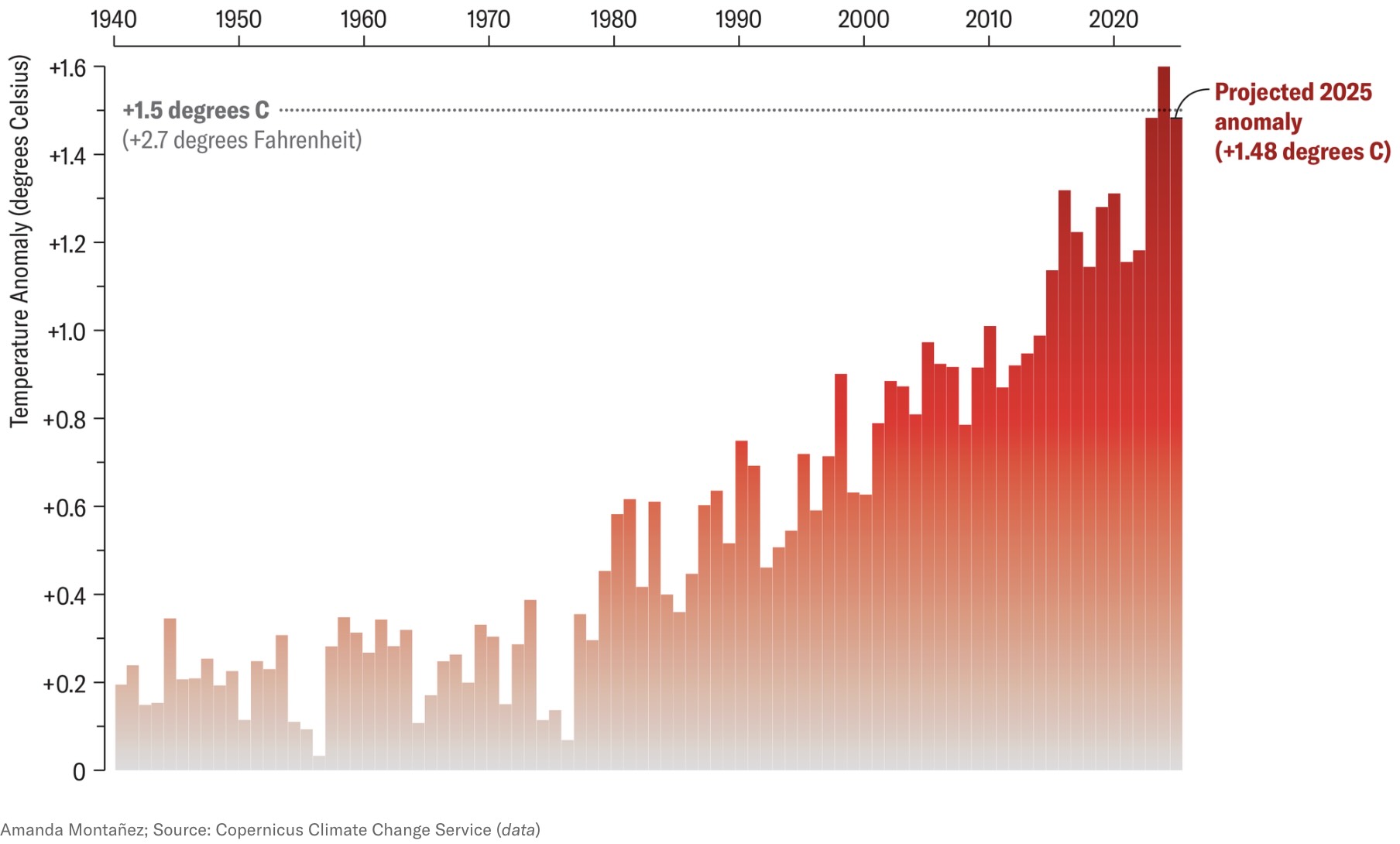
“Planetary warming has significantly accelerated over the past 10 years, with temperatures rising at a higher rate since 2015 than in any previous decade on record.
“The Earth warmed around 0.35 degrees Celsius in the decade to 2025, compared to just under 0.2C per decade on average between 1970 and 2015.
‘”The past three years have been the hottest on record, and in 2024, warming went past 1.5C, the lower limit set by the Paris Agreement.”– Bloomberg
February 26, 2026
Antarctica just saw the fastest glacier collapse ever recorded
“Antarctica’s Hektoria Glacier stunned scientists by retreating eight kilometers in just two months, with nearly half of it collapsing in record time. The rapid breakup was driven by a flat, underwater bedrock surface that allowed the glacier to suddenly float and fracture from below. Satellite and seismic data captured the dramatic chain reaction in near real time. The findings raise concerns that much larger glaciers could one day collapse just as quickly.” – ScienceDaily
February 24, 2026
Space lasers reveal oceans rising faster than ever
“A new 30-year analysis reveals that melting land ice is now the main force behind rising global sea levels. Researchers discovered that oceans rose about 90 millimeters since 1993, with most of the increase coming from added water mass rather than just warming expansion. Ice loss from Greenland and mountain glaciers accounts for the vast majority of this gain. Even more concerning, the rate of sea-level rise is accelerating.” – ScienceDaily
February 17, 2026
The grim message in the ‘rusting’ Arctic rivers
The bright orange waterways are a sign that permafrost is thawing rapidly, with potentially hazardous consequences
“In Alaska’s Brooks Range, a wilderness of rugged peaks and crystalline rivers just north of the Arctic Circle, a strange new force is blighting the landscape.
“Bright orange water is flowing through rivers in quantities visible from outer space. As with wastewater from mines, the rust-orange colour comes from iron that dissolves after exposure to acidic water. But in this case, mining isn’t the culprit, it’s global warming.
“‘I’ve been most startled by the spatial extent,’ says Brett Poulin, a scientist at the University of California, Davis who studies ‘rusting’ rivers. ‘And there’s no way to stop it,’ he adds. ‘Once it starts, it just starts.'” – Financial Times
February 12, 2026
Trump’s EPA repeals landmark climate finding in gift to ‘billionaire polluters’
Rollback of government’s ability to limit climate-heating pollution will make families ‘sicker and less safe’, environmental advocate says
“The Trump administration has revoked the bedrock scientific determination that gives the government the ability to regulate climate-heating pollution. The move was described as a gift to “billionaire polluters” at the expense of Americans’ health.
“The endangerment finding, which states that the buildup of greenhouse gases in the atmosphere endangers public health and welfare, has since 2009 allowed the Environmental Protection Agency (EPA) to limit heat-trapping pollution from vehicles, power plants and other industrial sources….
“The former secretary of state John Kerry called the new rule ‘un-American.’
“‘Repealing the Endangerment Finding takes Orwellian governance to new heights and invites enormous damage to people and property around the world,’ said Kerry, who also served as Joe Biden’s climate envoy. “Ignoring warning signs will not stop the storm. It puts more Americans directly in its path.’” – The Guardian
February 11, 2026
Point of no return: a hellish ‘hothouse Earth’ getting closer, scientists say
Continued global heating could set irreversible course by triggering climate tipping points, but most people unaware
“Continued global heating could trigger climate tipping points, leading to a cascade of further tipping points and feedback loops, they said. This would lock the world into a new and hellish ‘hothouse Earth’ climate far worse than the 2-3C temperature rise the world is on track to reach. The climate would also be very different to the benign conditions of the past 11,000 years, during which the whole of human civilisation developed.
“At just 1.3C of global heating in recent years, extreme weather is already taking lives and destroying livelihoods across the globe. At 3-4C, ‘the economy and society will cease to function as we know it,’ scientists said last week, but a hothouse Earth would be even more fiery.” – The Guardian
February 9, 2026
Global economy must move past GDP to avoid planetary disaster, warns UN chief
Exclusive: António Guterres says world’s accounting systems should place true value on the environment
“The global economy must be radically transformed to stop it rewarding pollution and waste, UN secretary general António Guterres has warned.
“Speaking to the Guardian after the UN hosted a meeting of leading global economists, Guterres said humanity’s future required the urgent overhaul of the world’s ‘existing accounting systems’ he said were driving the planet to the brink of disaster.
‘We must place true value on the environment and go beyond gross domestic product as a measure of human progress and wellbeing. Let us not forget that when we destroy a forest, we are creating GDP. When we overfish, we are creating GDP.’” – The Guardian
February 9, 2026
Economic growth is still heating the planet. Is there any way out?
Rising GDP continues to mean more carbon emissions and wider damage to the planet. Can the two be decoupled?
‘This week, the UN secretary general, António Guterres, called for economies to ‘move beyond GDP’ as a measure of progress, warning that the world’s ‘existing accounting systems’ were driving the planet towards disaster.
His remarks echo an increasingly influential school of economics, known broadly as ‘post-growth,’ that asks what was once unthinkable: will solving the climate crisis mean learning to live without constant expansion?
“Post-growth economists often reject GDP in favour of new frameworks that account for environmental damage – such as the ‘doughnut economics’ adopted recently by Amsterdam, or New Zealand’s attempt at a ‘wellbeing budget.’” – The Guardian
February 9, 2026
Forests are changing fast and scientists are deeply concerned
Forests may be growing faster—but they’re also becoming weaker, simpler, and far more vulnerable.
“Forests around the world are quietly transforming, and not for the better. A massive global analysis of more than 31,000 tree species reveals that forests are becoming more uniform, increasingly dominated by fast-growing ‘sprinter’ trees, while slow-growing, long-lived species are disappearing. These slower species act as the backbone of forest ecosystems, storing carbon, stabilizing environments, and supporting rich webs of life—especially in tropical regions where biodiversity is highest.” – ScienceDaily
February 6, 2026
An invisible chemical rain is falling across the planet
The chemicals that helped save the ozone layer are now coating the planet with a pollutant that may never go away.
“A new study reveals that chemicals used to replace ozone-damaging CFCs are now driving a surge in a persistent ‘forever chemical’ worldwide. The pollutant, called trifluoroacetic acid, is falling out of the atmosphere into water, land, and ice, including in remote regions like the Arctic. Even as older chemicals are phased out, their long lifetimes mean pollution is still rising.” – ScienceDaily
February 5, 2026
Climate crisis could cause global financial crash as economic models fail to capture risk
Researchers say governments and financial institutions underestimating threat because they rely on models that assume climate crisis impacts will be gradual
“The climate crisis could trigger a global financial crash as temperatures rise beyond 2C, but governments and investors are relying on economic models that fail to account for the scale and severity of the damage, new research warns.
“Researchers warn that governments and financial institutions are underestimating the threat because they rely on models that assume the impacts of the climate crisis will be gradual.
“The analysis finds that as global heating increases, climate damage is more likely to arrive through extreme weather, cascading disruptions and tipping points, rather than through slow, manageable changes to economic growth. These risks, the researchers say, are largely missing from the tools used to guide public policy and investment decisions.” – The Independent
January 30, 2026
Something Dark Is Growing on Greenland’s Ice. And Melting It Faster.
New studies show how algae grows on ice and snow, creating “dark zones” that exacerbate melting in the consequential region.
“On snow it’s green or red. On ice it’s a brownish gray. And it’s melting the frozen mass that encases Greenland faster and faster.
“As a warming climate eats away at the ice that covers most of the world’s largest island, algae blooms are speeding up that process, according to two new studies. Greenland is shedding hundreds of billions of tons of ice every year and raising sea levels as it does.” – New York Times
January 29, 2026
A breakthrough that turns exhaust CO2 into useful materials
“Scientists have created a device that captures carbon dioxide and transforms it into a useful chemical in a single step. The new electrode works with realistic exhaust gases rather than requiring purified CO2. It converts the captured gas into formic acid, which is used in energy and manufacturing. The system even functions at CO2 levels found in normal air.” – ScienceDaily
January 29, 2026
US leads record global surge in gas-fired power driven by AI demands, with big costs for the climate
Projects in development expected to grow global capacity by nearly 50% amid growing concern over impact on planet
“The US is leading a huge global surge in new gas-fired power generation that will cause a major leap in planet-heating emissions, with this record boom driven by the expansion of energy-hungry datacenters to service artificial intelligence, according to a new forecast.
“This year is set to shatter the annual record for new gas power additions around the world, with projects in development expected to grow existing global gas capacity by nearly 50%, a report by Global Energy Monitor (GEM) found.
“The US is at the forefront of a global push for gas that is set to escalate over the next five years, after tripling its planned gas-fired capacity in 2025. Much of this new capacity will be devoted to the vast electricity needs of AI, with a third of the 252 gigawatts of gas power in development set to be situated on site at datacenters.
“All of this new gas energy is set to come at a significant cost to the climate, amid ongoing warnings from scientists that fossil fuels must be rapidly phased out to avoid disastrous global heating.” – The Guardian
January 21, 2026
The world’s mountains are warming faster than anyone expected
The world’s mountains are changing fast—and the water, weather, and ecosystems billions rely on are changing with them.
“Mountain regions around the world are heating up faster than the lands below them, triggering dramatic shifts in snow, rain, and water supply that could affect over a billion people. A major global review finds that rising temperatures are turning snowfall into rain, shrinking glaciers, and making mountain weather more extreme and unpredictable. These changes threaten water sources for huge populations, including those in China and India, while also increasing risks of floods, ecosystem collapse, and deadly weather events.” – ScienceDaily
January 20, 2026
Era of ‘global water bankruptcy’ is here, UN report says
Overuse and pollution must end urgently as no one knows when whole system might collapse, says expert
“The world has entered an era of ‘global water bankruptcy’ that is harming billions of people, a UN report has declared.
“The overuse and pollution of water must be tackled urgently, the report’s lead author said, because no one knew when the whole system could collapse, with implications for peace and social cohesion.
“All life depends on water but the report found many societies had long been using water faster than it could be replenished annually in rivers and soils, as well as over-exploiting or destroying long-term stores of water in aquifers and wetlands.
“This had led to water bankruptcy, the report said, with many human water systems past the point at which they could be restored to former levels. The climate crisis was exacerbating the problem by melting glaciers, which store water, and causing whiplashes between extremely dry and wet weather.” – The Guardian
January 17, 2026
Microplastics are undermining the ocean’s power to absorb carbon
“Tiny plastic particles drifting through the oceans may be quietly weakening one of Earth’s most powerful climate defenses. New research suggests microplastics are disrupting marine life that helps oceans absorb carbon dioxide, while also releasing greenhouse gases as they break down. By interfering with plankton, microbes, and natural carbon cycles, these pollutants reduce the ocean’s ability to regulate global temperatures.” – ScienceDaily
January 14, 2026
The ocean absorbed a stunning amount of heat in 2025
“Earth’s oceans reached their highest heat levels on record in 2025, absorbing vast amounts of excess energy from the atmosphere. This steady buildup has accelerated since the 1990s and is now driving stronger storms, heavier rainfall, and rising sea levels. While surface temperatures fluctuate year to year, the ocean’s long-term warming trend shows no sign of slowing.” – ScienceDaily
January 14, 2026
The World Is in the Midst of an ‘Extreme’ Temperature Spike
“Last year was the third hottest on record, according to an analysis of temperature data released Wednesday by three independent agencies. That puts 2025 just behind the second-hottest year, 2023, and the hottest, 2024.
“What makes this result extraordinary, scientists say, is that 2025 saw a cooling phase in the equatorial Pacific Ocean, or La Niña, that suppresses global temperatures. In other words: Heat from greenhouse gases countered that cooling influence enough that the year still landed among the very warmest.” – Bloomberg
January 14, 2026
Earth to breach 1.5C warming a decade early, scientists say
EU’s Copernicus observation service sees temperatures passing Paris goal by 2030
“Scientists believe irreversible changes to the planet will begin if temperatures over 1.5C are sustained over decades, endangering human health, food security, water supplies and economic growth.
“’To all intents and purposes, the 1.5C limit is now dead in the water,’ said Bill McGuire, professor of geophysical and climate hazards at University College London. ‘Whichever way you look at it, dangerous climate breakdown has arrived, but with little sign that the world is prepared, or even paying serious attention.’ – The Financial Times
January 9, 2026
Oceans are storing record heat, intensifying climate disasters
“The world’s oceans absorbed unprecedented amounts of heat in 2025, setting a new record and intensifying extreme weather events. Scientists report that oceans take up more than 90% of the heat trapped by human-caused carbon pollution, making ocean warming one of the clearest indicators of the accelerating climate crisis. This excess heat is fueling stronger hurricanes and typhoons, heavier rainfall and flooding, prolonged marine heatwaves that devastate ocean life, and rising sea levels through thermal expansion—threatening billions of people worldwide. Researchers warn that the oceans are likely hotter than at any point in at least 1,000 years and are warming faster than at any time in the past 2,000 years. Because the atmosphere is more affected by natural climate variability, scientists emphasize that “global warming is ocean warming”, and that ocean heat content provides the most reliable measure of how rapidly the planet is heating—until emissions fall to zero.” – The Guardian
January 8, 2026
India arrests prominent climate activist for campaigning against fossil fuels
Financial crimes agency raids Harjeet Singh’s home and office after accusing him of using foreign funds to promote an international green initiative
“Indian authorities raided a prominent climate activist’s home and office, accusing him of using foreign funding to campaign against fossil fuels in ways that could undermine the country’s energy security.
“Investigators searched properties linked to Harjeet Singh, a long-time climate campaigner, and his wife Jyoti Awasthi earlier this week. The couple are co-founders of Satat Sampada, an organisation that works on climate action, sustainable development, and organic farming….
“The initiative is an international campaign calling for a binding agreement to stop the expansion of new coal, oil and gas projects and to manage a gradual phaseout of fossil fuels. It is backed by several nations, including small island states, as well as the World Health Organisation and the European parliament.” – Independent


